

Managing an offshore team requires more than just tracking task completion rates or monitoring productivity software. Many companies make the mistake of focusing only on output or slipping into micromanagement, which can harm team dynamics and slow business growth.
A balanced performance framework for offshore teams supports the entire team by combining key performance indicators (KPIs), team communication, project management tools, and regular feedback systems that improve team performance over time. It aligns offshore operations with business goals, enhances collaboration between onshore and offshore teams, and ensures overall team performance stays on track across time zones.

The 4 Pillars of a Balanced Offshore Performance Framework
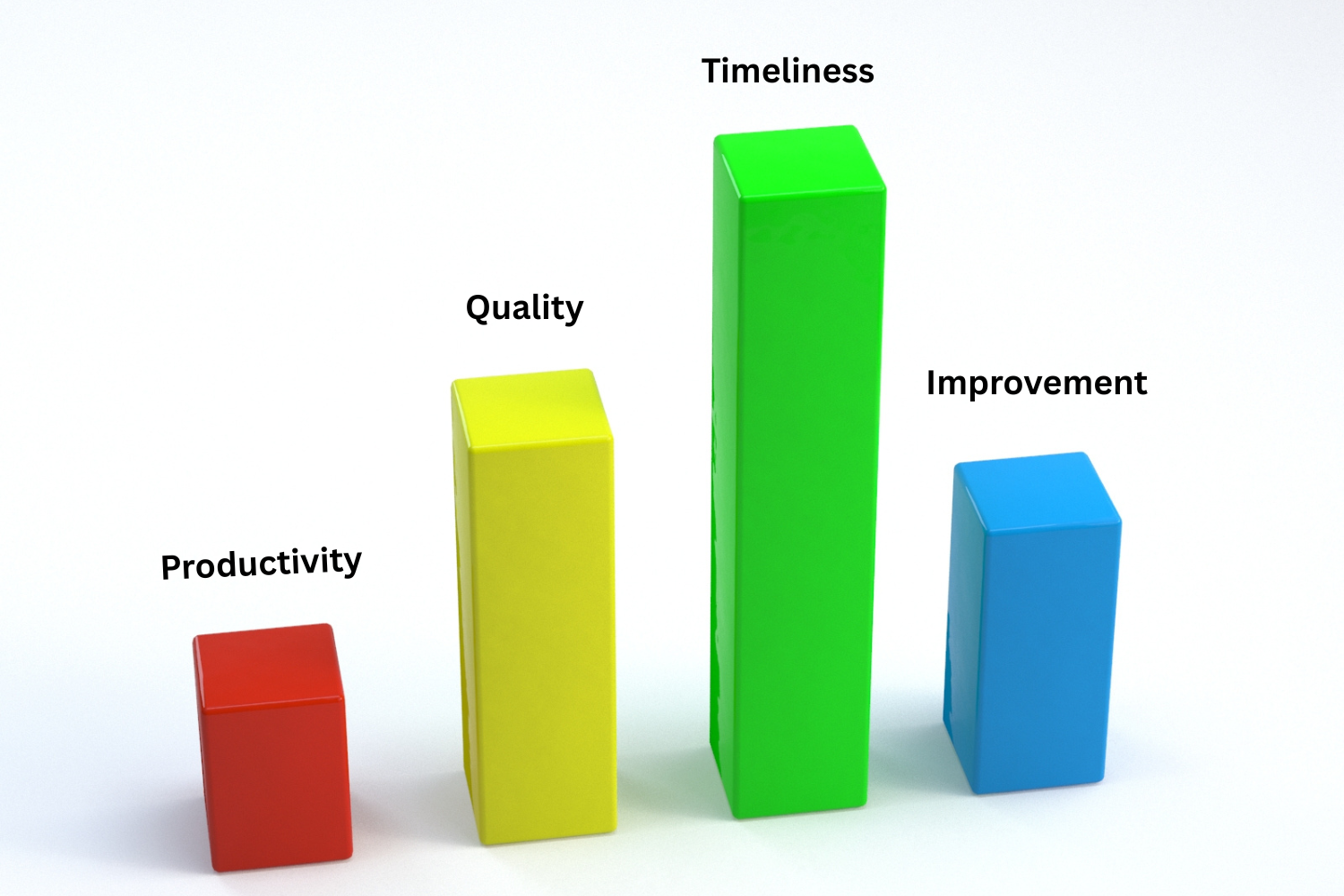
A strong performance framework for offshore teams should measure more than just raw output. It must balance four core areas: productivity, quality, timeliness, and continuous improvement. These pillars help align offshore development teams and dedicated offshore teams with specific business functions and long-term business objectives.
Productivity Metrics – How much gets done
Productivity metrics show how much work your offshore team members are completing. These numbers help track progress and resource allocation across the development process, especially during a software development project or payroll processing task. The focus is on volume and capacity, not just speed.
- Task completion: Tracks how many assigned tasks are finished in a given period
- Throughput: Measures how much work flows through the system or project pipeline
- Utilization rate: Shows how much of a team member’s available time is spent on productive tasks
Quality Metrics – How well the work is done
Quality metrics measure the standard of the output, not just quantity. These indicators are vital for evaluating offshore team performance in software development, customer service, and content production. They help monitor output quality and may support efforts toward meeting client expectations and compliance requirements.
- Accuracy: Tracks how often work is completed without errors
- Client satisfaction: Uses ratings or surveys to reflect how well deliverables meet expectations
- Error rate: Measures how often mistakes or defects occur in submitted work
Timeliness Metrics – How fast it’s delivered
Timeliness metrics help gauge how reliably offshore team members meet project timelines. For onshore and offshore teams working across time zone differences, these KPIs keep the team on the same page and avoid delays in project documentation or software development stages.
- Response time: Measures how quickly team members reply to messages or tickets
- On-time delivery: Tracks the percentage of tasks or projects completed by the agreed deadline
- Resolution time: Calculates how long it takes to solve assigned issues or requests
Improvement Metrics – What gets better over time
Improvement metrics focus on how offshore talent grows and contributes to long-term team success. These indicators show how well the team supports continuous improvement, enhances collaboration, and strengthens your offshoring strategy framework.
- Process suggestions: Tracks how often team members propose new ways to improve business processes
- Learning efforts: Includes training participation, upskilling, or knowledge transfer across the team
- Efficiency gains: Measures time or cost savings achieved through better workflows or ideas
Why Cultural Fit Matters When Measuring Offshore Team Performance
Understanding culture is key to building a performance framework that improves team performance without damaging morale. For dedicated offshore teams, success depends on measuring in ways that respect values, not just metrics.
Filipino work culture and how it affects measurement
In Filipino work culture, team harmony and mutual respect often matter more than individual competition. Offshore team members may avoid direct confrontation and prefer group recognition over personal praise. This affects how key performance indicators should be framed.
When performance reviews or project management tools focus only on data, they can miss key signals like communication effectiveness or morale shifts. To improve offshore team performance in the Philippines, leaders must build trust, offer regular feedback in private, and use performance monitoring tools that highlight team wins instead of individual shortcomings.
The risk of applying Western frameworks too rigidly
A rigid offshoring strategy that uses dashboards or rankings that ignore local work culture may cause misunderstandings or reduce engagement. Offshore development teams may feel pressured by rankings or constant evaluations, which can hurt the team’s ability to meet business goals. When tools are seen as punishment rather than support, team members resist them.
Instead of strict enforcement, your outsourcing strategy should include virtual team-building activities, ongoing support, and performance reviews that reflect shared goals. This approach may strengthen offshore partner relationships and better align teams with business objectives.

Adapting the Framework to Different Offshore Roles
Different roles need different metrics. To improve offshore team performance across the board, the performance framework must match each role’s tasks, goals, and work style.
Virtual assistants
Virtual assistants support specific business functions like scheduling, email management, and data entry. A strong framework should combine output-based metrics like task completion rate with quality checks such as accuracy and response time. Including KPIs like how fast they respond during work hours and how often they complete tasks without errors ensures operational efficiency and improves communication effectiveness with onshore teams.
Developers and tech staff
For offshore development teams, performance metrics must reflect more than just speed. Code quality, bug frequency, problem-solving, and project documentation matter just as much. A reliable performance framework for offshore teams in software development should measure how well developers follow the development process, handle complex technical issues, and contribute to knowledge transfer across the team.
Creative and customer-facing roles
These roles involve tone, empathy, creativity, and direct client interaction. Key performance indicators (KPIs) must go beyond numbers. For example, content quality or customer satisfaction can’t be measured only through volume. Instead, combine standard KPIs with feedback-based scores from team meetings, client reviews, or soft-skill rubrics. This gives a fuller picture of each team member’s contribution to team success.

How to Implement a Balanced Framework Step-by-Step
A good offshoring strategy starts with clear expectations and grows with consistent follow-through. Building a performance framework for offshore teams requires structure, transparency, and tools that support the entire team.
Start with clear role definitions and outcomes
Begin with defining what success means for each role. For offshore operations to run smoothly, the team must understand expectations around project requirements, task tracking, and business outcomes. Each offshore team member should understand their responsibilities and how their role contributes to team goals and timelines.
Map metrics to real business goals
Performance metrics only matter if they serve the business. Connect each KPI to results like increased revenue, customer retention, higher efficiency, or improved satisfaction. For example, in a software development project, on-time code delivery can be tied to product launch schedules, while customer satisfaction scores from support teams can link directly to churn rates or upsell success.
Share KPIs transparently and revisit regularly
Offshore team performance improves when KPIs are clear and consistent. Filipino offshore talent values structure and appreciates regular feedback. Share expectations upfront during onboarding and review metrics during performance reviews or team meetings. Revisiting KPIs allows room for continuous improvement as project needs and business goals change.

Tools and Templates to Support the Framework
Performance monitoring depends on having the right tools and templates. These resources help ensure consistent evaluation across onshore and offshore teams and allow leaders to track progress without micromanaging.
Role-based KPI documents
Each role should have a clear KPI reference that outlines how performance will be measured. These documents help align offshore talent with team dynamics and strategic objectives.
Key fields to include:
- Metric: What is being measured (e.g., resolution time, code quality)
- Definition: A clear explanation of the metric
- Target: The expected number or range
- Frequency: How often the metric is reviewed (weekly, monthly)
Lightweight tracking tools that work in the Philippines
Tools should support performance monitoring without draining bandwidth or causing frustration. These tools are commonly used by teams working across time zones or in areas with limited infrastructure, depending on needs and setup.
Examples:
- Time Doctor: Offers time tracking features often used by offshore teams, supporting varying connectivity conditions.
- ClickUp: Combines task management, timelines, and performance dashboards.
- Notion: Great for KPI documentation, check-ins, and task tracking.
- Google Docs: Useful for collaborative documentation, assuming stable internet access.
Dashboards vs. check-ins—when to use each
Both dashboards and check-ins are helpful in tracking offshore team performance, but they serve different purposes. Use them based on what you need to evaluate and how your offshore model works.
| Feature | Dashboards | Check-Ins |
|---|---|---|
| Best for | Real-time performance metrics and status updates | Relationship-building and nuanced performance discussions |
| Use case | Software development project tracking, task completion rate | Creative roles, customer support, virtual team building activities |
| Frequency | Continuous or weekly | Weekly, bi-weekly, or monthly |
| Communication style | One-way updates | Two-way conversation with room for clarification |
| Value | Shows trends and data for decision-making | Builds trust, improves feedback culture, and supports team success |

Designing a Performance Framework That Actually Works for Offshore Teams
A well-designed performance framework can balance results and relationships when adapted to team context and goals. The best systems track what matters most—productivity, quality, timeliness, and improvement—while respecting team values, communication styles, and cultural norms.
Align your performance metrics with business goals, use the right tools, and commit to regular reviews. This approach helps offshore talent grow, improves team performance, and keeps your business moving forward with confidence.
Frequently Asked Questions
What’s the difference between a balanced and rigid KPI system?
A balanced system adapts to team needs and culture, while a rigid one applies fixed rules without context.
How often should I update offshore team KPIs?
Review KPIs quarterly or when business objectives, roles, or performance trends shift.
How do I track qualitative performance without bias?
Use structured feedback rubrics and multiple input sources like peer reviews or customer feedback.
What tools work best for Filipino remote teams?
Time Doctor, ClickUp, Notion, and Google Docs are reliable for tracking, collaboration, and feedback.
Can one framework work across different offshore roles?
Yes, if the core structure stays flexible and the KPIs are customized for each role’s tasks and outcomes.
References
- International Labour Organization. (2021). Working from home: From invisibility to decent work. https://www.ilo.org/sites/default/files/wcmsp5/groups/public/@ed_protect/@protrav/@travail/documents/publication/wcms_765896.pdf
- National Institute of Standards and Technology (NIST). (2025). Baldrige Performance Excellence Program. https://www.nist.gov/baldrige
- National Privacy Commission (Philippines). (2020). NPC issues ‘work from home’ guidelines to safeguard personal data.
- OECD. (n.d.). OECD Business and Finance Outlook. https://www.oecd.org/en/publications/oecd-business-and-finance-outlook_26172577.html
- Philippine Statistics Authority. (2021). Home Labor Force Survey. https://psa.gov.ph/statistics/labor-force-survey/released/2021
- USA.gov. (n.d.). Wage and Hour Division (WHD). https://www.usa.gov/agencies/wage-and-hour-division